
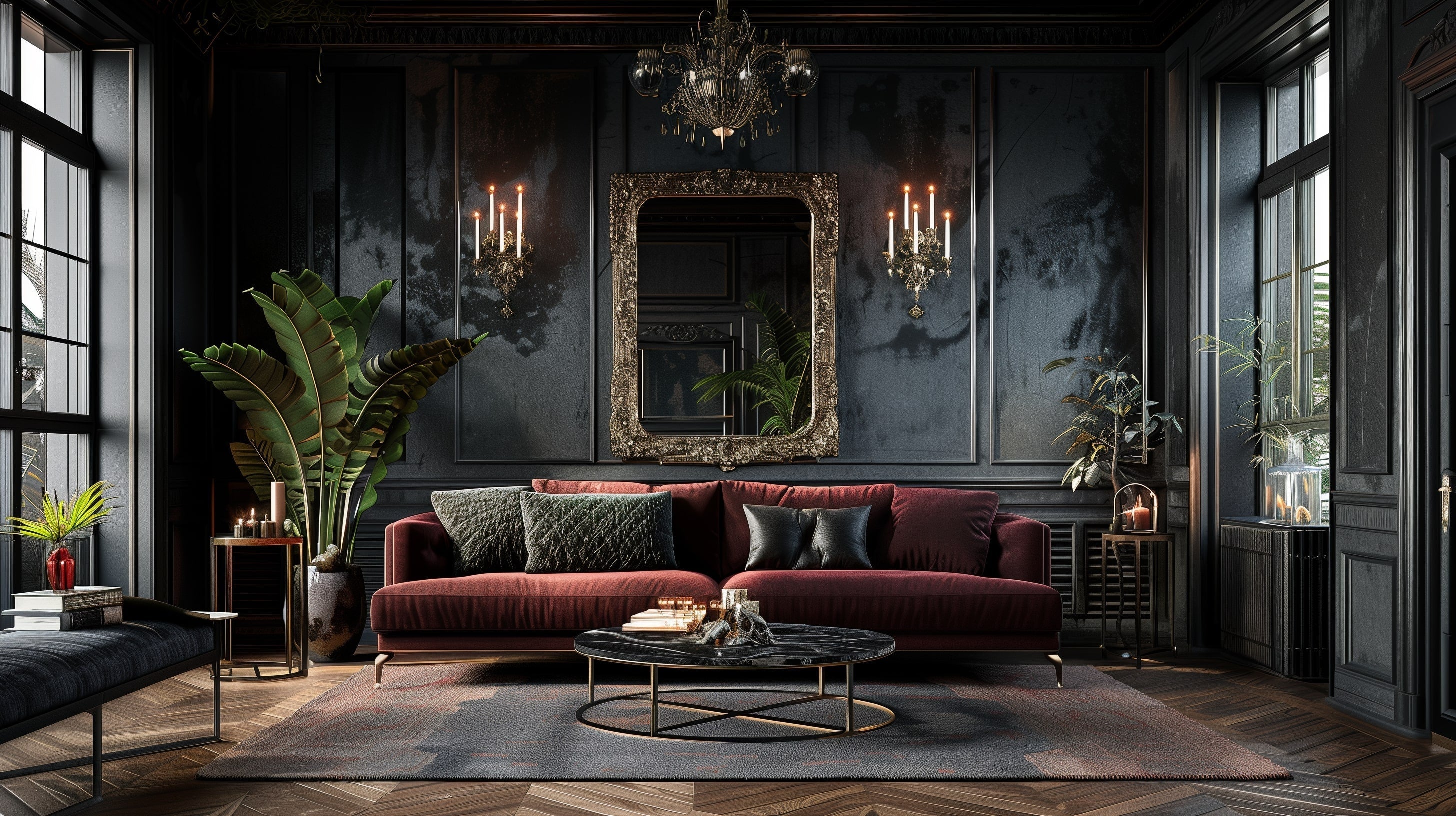
Gothic vs. Modern Dark Academia: Finding Calm in the Shadows
When someone mentions dark style, most minds go straight to haunted castles and moonlit corridors. But darkness wears more than one face. Gothic and Modern Dark Academia, two aesthetics often mistaken for siblings, actually live in different worlds. They share moody DNA, but their instincts are not the same.
The AURA Blueprint
These two aesthetics overlap in mood, not in intent. Gothic turns shadow into theater. Modern Dark Academia turns it into atmosphere for reading, working, and thinking.
- Choose the base language. Gothic works best when the room can carry drama. Dark Academia works best when the room is built around ritual, study, and patina.
- Let materials decide. Velvet, smoked glass, and blackened finishes absorb and sharpen light differently than walnut, leather, wool, and linen.
- Avoid the common mistake. Splitting the room fifty-fifty usually reads like set dressing. Start with one dominant mood, then borrow accents from the other.
- Design for real light. Gothic falls flat without layered lighting. Dark Academia turns muddy when every brown and green lands at the same temperature.
One wears its darkness like a costume. The other keeps it tucked into walnut shelves, marked-up books, and a brass lamp left on after midnight. To understand why they both feel magnetic, it helps to slow down and study their differences, how each turns shadow into beauty in its own way.

Gothic vs. Modern Dark Academia
At first glance, it is easy to place these two in the same moody family portrait. Look closer and the separation becomes obvious. Gothic is outward-facing. It likes height, drama, silhouette, and symbolism. Dark Academia is inward-facing. It prefers concentration, quiet repetition, and objects that suggest a life of reading, collecting, and returning to the same room at the same hour.
That difference matters in interiors. Gothic asks the room to perform. Dark Academia asks the room to hold thought. One can be sensual and theatrical, with velvet, blackened finishes, antique silver, and a stronger sense of spectacle. The other feels steadier, built from walnut, leather, wool, paper, and warm pools of task light.
While Academia relies on curated collections and vintage layers, those seeking a more restrained, architectural approach should explore our guide to dark modern minimalism, which prioritizes negative space and light reflectance as design tools. If you’re leaning toward the scholar’s side, explore our complete Dark Academia home decor guide for palettes, materials, and room-by-room styling.
| Aspect | Gothic | Modern Dark Academia |
|---|---|---|
| Visual Motifs | Arches, tracery, ornate frames, dramatic drapery | Books, handwritten notes, crests, study objects |
| Color Palette | Black, bruised plum, oxblood, deep jewel tones | Walnut brown, moss green, tobacco, soft cream |
| Emotional Tone | Intense, dramatic, expressive | Reflective, private, bittersweet |
| Best Room Energy | Statement-making, atmospheric, theatrical | Collected, studious, quietly immersive |
| Settings | Cathedrals, manor interiors, candlelit salons | Libraries, lecture halls, paneled studies |
Both reflect different kinds of longing, Gothic for the stage, Dark Academia for the study hall. Or put more simply, Gothic wears its shadow, Dark Academia reads by it.
Historical Backgrounds

Gothic culture took shape around late-1970s and early-1980s post-punk scenes. It was never just a soundtrack. It was a visual language for melancholy, romance, rebellion, and ritual. The aesthetic side grew naturally from that emotional stance, lace, leather, black tailoring, silvered mirrors, candlelight, and a fascination with the sacred and the macabre.
Modern Dark Academia arrived by a different route. It gained momentum online through image culture, reading communities, campus nostalgia, and a renewed fascination with the rituals of scholarship. Instead of nightlife, it romanticized study. Instead of public spectacle, it leaned into private atmosphere: library lamps, worn blazers, old editions, paneled walls, and the belief that a room should sharpen the mind as much as please the eye.
Apply it at home:
- Gothic: Play with contrast through black limewash walls, oxblood velvet, smoked glass, and aged brass that catches light in small flashes.
- Dark Academia: Lean warm with walnut shelving, tobacco leather, moss-green wool, linen drapery, and enough negative space to keep the room from feeling staged.
To truly lean into this immersion without breaking the room’s silhouette, many designers are turning to color drenching to unify the walls, trim, and ceiling.
Evolution of Dark Academia
Dark Academia is nostalgia dressed in tweed, but its appeal goes beyond costume. At its best, it offers a usable kind of mood. The palette, muted browns, moss greens, faded creams, and tobacco tones, feels grounded because those colors tend to age well in real rooms. Walnut deepens under warm bulbs. Leather gains character. Brass softens. Linen keeps the heavier finishes breathable.
Books like The Secret History and films like Dead Poets Society gave the aesthetic its emotional vocabulary: intelligence tinged with tragedy, discipline softened by longing. The modern version matters because it translated that mood from clothing and internet imagery into rooms people actually want to inhabit.
Today’s spectrum stretches from neon-lit Cyber-Goth to sunlit Light Academia, with hybrid moments, dark velvet meeting tweed, appearing in contemporary moody interiors. The stronger interiors do not imitate a fantasy wholesale. They edit it down to materials, light, and habit.
Architectural Influence

If these styles had permanent addresses, Gothic would live in a cathedral and Dark Academia in a university library. That architectural difference explains a great deal about how they should be translated at home.
Gothic reaches upward. It likes pointed arches, carved detail, stained glass effects, darker contrast, and a stronger sense of silhouette. Even when used lightly, it benefits from a room with some visual gravity, higher ceilings, heavier millwork, taller drapery, or at least one dramatic focal point.
Modern Dark Academia borrows from Collegiate Gothic but quiets it down. Think symmetry, wood paneling, brick, walnut, leather, and a room arranged around concentration rather than awe. In practice, this is often easier to live with. A study, den, library wall, or dining nook can carry the mood without asking the whole home to become theatrical.
The common mistake is borrowing Gothic shapes without the architecture to support them. A pointed mirror and black paint alone rarely create atmosphere. They often just flatten the room.
If the room is modest in scale, Dark Academia is usually the safer base. Save Gothic for the pieces that can carry drama on their own, a smoked-glass pendant, a carved frame, a darker stone top, or one decisive velvet accent.
Design translation:
- Gothic: black limewash paneling, ebonized oak, smoked glass lanterns, aged brass hardware.
- Dark Academia: walnut built-ins, banker’s lamps with amber bulbs, leather-topped desks, unlacquered brass.
Both honor craft and history, but one builds for awe and the other for thought.
Materials and Styling Cues for Interiors

This is where the distinction becomes usable. Gothic materials tend to absorb light and sharpen contrast. Velvet goes almost black in low light. Smoked glass deepens a shadow line. Ebonized wood creates weight. Silvered or aged metal throws back small glints, which keeps the room from becoming visually dead.
Dark Academia relies on a different material rhythm. Walnut warms the room even when the palette stays deep. Leather adds patina instead of gloss. Wool and linen keep heavy furniture from feeling overcomposed. The mood is still dark, but the darkness feels inhabited, as if the room has been used for years rather than staged for a photograph.
| Aspect | Gothic Style | Modern Dark Academia |
|---|---|---|
| Color Palette | Deep black, crimson, plum, jewel tones | Brown, beige, green, charcoal, cream |
| Materials | Velvet, leather, lace, ebonized oak, smoked glass | Wool, cotton, linen, walnut, leather, unlacquered brass |
| Silhouettes and Forms | Baroque mirrors, arches, dramatic drapery | Tailored upholstery, paneled walls, clean-lined shelves |
| Accessories | Ornate metalwork, antique frames, dark stone | Leather trays, fountain pens, stacked books, botanical studies |
| Lighting | Dramatic uplights, smoked glass pendants | Banker’s lamps, warm task lighting, amber bulbs |
Apply it at home:
- Gothic: Oxblood velvet pillows, black-framed art, antique silver candlesticks, dark marble.
- Dark Academia: Botanical prints, linen curtains, vintage globes, leather-bound book stacks.
If Gothic says “see me,” Dark Academia says “stay awhile.”
Literary and Artistic Themes

Gothic literature thrives on obsession, mortality, ruined beauty, spiritual dread, and the pleasure of excess. It is a world of storm light, candlelight, stone, velvet, and the feeling that emotion has tipped past restraint. Interiors borrowed from this tradition often work best when they accept a little severity.
Dark Academia draws from classics, campus mythology, tragic ambition, and the romance of study. Its emotional range is quieter but no less intense. The atmosphere comes less from horror and more from private longing, intellectual pressure, and the beauty of repetition, a chair always pulled to the same desk, a stack of annotated books, a lamp that makes the room feel smaller and more intimate.
| Theme | Gothic | Dark Academia |
|---|---|---|
| Literary Focus | Horror, the supernatural, tragedy | Classics, ambition, existential reflection |
| Artistic Style | High contrast, deep shadow, ornament | Muted tones, scholarly motifs, softer melancholy |
| Emotional Tone | Intense, dramatic | Reflective, bittersweet |
| Icons | Shelley, Stoker | Wilde, Fitzgerald |
| Settings | Cathedrals, crypts, manor houses | Libraries, lecture halls, old studies |
If Gothic is Stoker by candlelight, Dark Academia is Tartt annotated in the margins.
Cultural Significance and Community

Every subculture builds its own kind of home. Gothic tends to gather in public, through music, nightlife, spectacle, and shared performance. Dark Academia tends to gather in quieter ways, through reading lists, campus imagery, online communities, and conversations about literature, philosophy, and visual mood.
That difference matters because it changes what each aesthetic asks from a room. Gothic often wants the room to announce itself. Dark Academia wants the room to reward time spent inside it. One moves outward. The other settles inward.
| Community | Gothic | Dark Academia |
|---|---|---|
| Gathering Style | Concerts, festivals, clubs | Online forums, study groups, reading communities |
| Connection | Music and performance | Literature and philosophy |
| Tone | Expressive, theatrical | Thoughtful, nostalgic |
Both create sanctuary. One dances through the dark. The other reads through it.
Evolving Trends and Modern Takes

Neither Gothic nor Dark Academia stays frozen. Gothic continues to split into softer romantic versions and more futuristic hybrids. Dark Academia has broadened too, sometimes becoming lighter, cleaner, and less costume-driven. That shift is useful for interiors because it gives more room for editing.
The best modern interpretations understand restraint. A room does not need a skull motif or a stack of Latin editions to communicate mood. Often the stronger move is simpler: darker wood, warmer bulbs, one velvety note, one brass note, one disciplined shelf, one shadowed corner that feels intentional instead of underlit.
| Aspect | Gothic Dark Romance | Modern Dark Academia |
|---|---|---|
| Materials | Velvet, silk, lace | Wool blends, tweeds, walnut, leather |
| Accessories | Antique jewelry, ornate metalwork | Round glasses, leather satchels, study objects |
| Color Focus | Black, deep reds, jewel tones | Browns, greens, creams |
| Influence | Baroque romance, punk defiance | Classical literature, campus atmosphere |
| Mood | Rebellion through drama | Reflection through intellect |
Whether you wear your darkness or study it, both aesthetics prove the same thing: shadow is not something to escape. It is something to compose carefully.
End Note
Some of us crave the cathedral. Others crave the library. The truth is that both are sanctuaries. Gothic and Dark Academia do not compete so much as they reveal different emotional uses for darkness. One heightens feeling. The other deepens thought.
If you are deciding between them for your home, start with the life you actually want the room to hold. Choose Gothic when you want visual drama, stronger contrast, and a little ceremony. Choose Modern Dark Academia when you want warmth, concentration, patina, and a mood that improves the longer you live with it. Ready to start building your sanctuary? Shop Dark Academia items from our latest collection to find the perfect pieces for your home.
Frequently Asked Questions

Todd Harmon
The line between Gothic and Dark Academia is rarely just a matter of taste. It is a question of how a room handles shadow, whether it turns darkness into theater or lets it settle into wood, leather, brass, and the quieter rituals of daily life. With over two decades in e-commerce and product curation, Todd’s work is defined by a rejection of sterile minimalism in favor of the "moody interior." As the creative architect behind AURA Modern Home, his focus lies at the intersection of mid-century architecture and contemporary shadow, prioritizing material authority and the psychological impact of a well-composed room.


1 comment
Wonderful article that reflects the comparison perfectly. However, there is also the Gothic Academia which borrows from both.
Neveen Badr
Leave a comment
This site is protected by hCaptcha and the hCaptcha Privacy Policy and Terms of Service apply.