
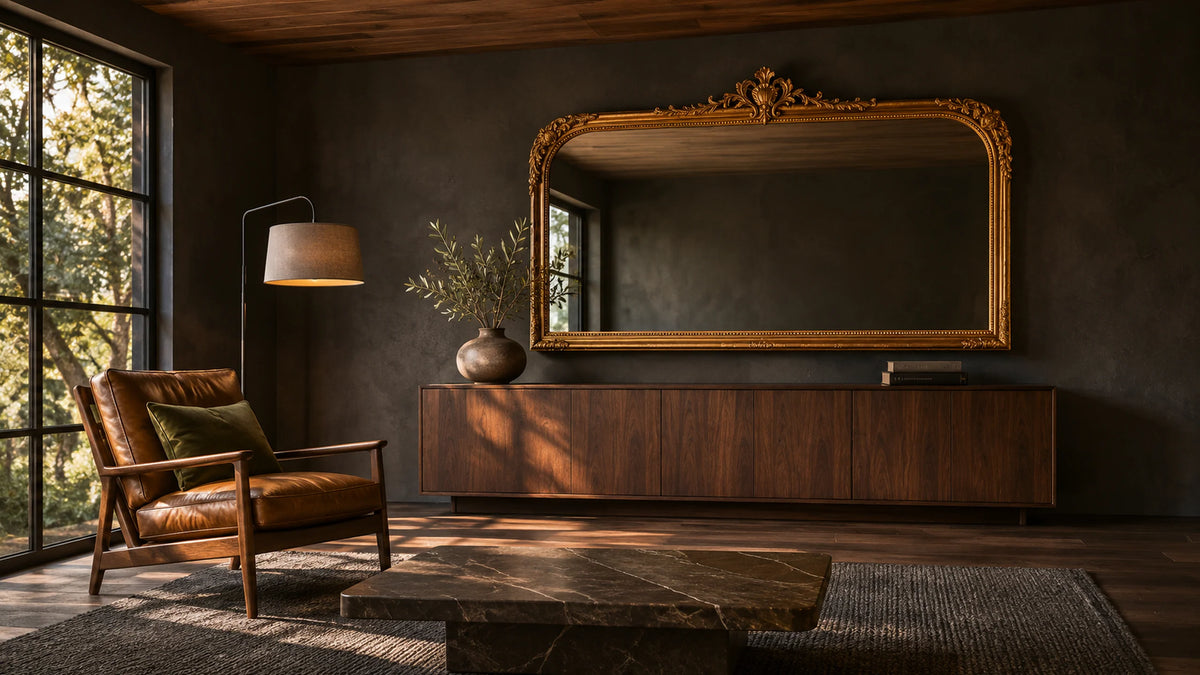

To style an antique gold mirror in a modern room, first decide where you want the eye to land. A carved crest draws attention above a flat-front walnut console. Over a strongly veined stone top, a slim frame lets the pattern of the stone stand out. Then check the reflection from the place you’ll use the mirror. A frame you love from the doorway can still put a bare bulb in view from your reading chair.
The AURA Blueprint
Judge the mirror as part of the wall, not as an isolated decorative object. Its outline, usable reflection, and mounting method are separate decisions; a convincing arrangement needs all three to work.
- Choose the lead. Give a worked, ornamental frame a broad, quiet surface beneath it. If the furniture already has intricate detailing, let the mirror provide a simpler outline.
- Connect through materials. Walnut, brown leather, or a warm neutral rug can echo antique gold without introducing more metallic finishes. Keep the hardware you already like.
- Check the view. Look from the doorway and your usual seat. Return in the evening to see where lamps and exposed bulbs appear in the glass.
- Read the specifications. Separate overall dimensions from usable glass, and frame material from finish. Confirm the weight and approved mounting method. If age matters, ask how the seller established it.
Antique Gold Mirror Styling Starts With the Frame

Compare two product photographs with the glass covered by a slip of paper. Look at the outline before the reflection. A narrow rectangle gives a patterned room a quiet edge. A crest or scalloped corner can be the detail that makes a plain console wall interesting. Uncover the glass and consider its purpose: a generous ornamental border may be welcome in a decorative piece, but it should not crowd out the reflection you need for grooming.
The degree of ornament matters as much as the shape. Deep carving creates small pockets of shadow, particularly on a dark wall under directional light. A flatter frame reads more like a continuous border. The first can give an otherwise restrained room a focal point; the second is easier to place where the furniture, stone, or artwork already has a strong presence.
Read the finish description carefully. In a new-mirror listing, antique gold describes an aged-looking finish, not evidence that the object is old or made from gold. Antiqued mirror glass is a separate feature of the reflective surface. For a vintage piece, ask how the seller dated the frame and glass, and what has been replaced or repaired. A maker's label, documented ownership history, or receipt tied to the piece gives you something more useful to examine than a convincing photograph.
Do not confuse convincing patina with good condition. Worn high points and fine surface cracks differ from lifting gilding, opening joints, or loose ornament. Request close photographs of the corners and crest. An unstable finish needs a conservator's assessment, not a reassurance that the piece simply has character.
Consider the Ambella Home Key Hole Mirror in AURA's collection. Its aged effect comes from several different surfaces. Ambella specifies medium-density fiberboard (MDF) and solid wood with an antique-gold finish. An antiqued mirror border, detailed with carved bull's-eye motifs, surrounds a clear central mirror. The border contributes ornament, while the center supplies the uninterrupted reflection.
Ambella lists exterior dimensions of 30 inches wide, 54 inches high, and 5 inches deep, with a weight of 81 pounds. Those are whole-piece measurements, not dimensions of the clear center. The maker's specification sheet does not provide usable measurements for that opening, so request them when grooming is a priority. The 5-inch depth also deserves attention on a narrow entryway wall, where you will see the piece from the side as well as the front.
Once you know the outline that fits your wall, compare antique gold mirrors within that size range. If two frames fit above an entry console, consider how much clear glass each provides for a last glance on your way out. Above a dining sideboard, you might deliberately give more of that space to an ornamental border.
Pair the Gold With Wood, Stone, and Black Metal

Begin with the largest surface the mirror will sit beside, such as a cabinet front, stone mantel, or uninterrupted stretch of plaster. Then step back far enough to see the floor. A patterned entry rug may already bring all the ornament the lower half of the room needs.
A useful pairing often allows one surface to carry detail while the other stays quieter. Judge the grain, pattern, and shape together. Two materials can share a warm undertone and still compete if both have elaborate outlines.
| Material already in the room | A useful pairing | What to watch |
|---|---|---|
| Walnut or oak | A flat-front cabinet or straight-legged console beneath a more decorative frame. | Carved furniture can repeat too much of the frame's detail. Beside orange-toned wood, compare browner gold finishes before choosing a strongly yellow one. |
| Limestone, travertine, or marble | A plain stone slab, plinth, or simple fireplace surround that contrasts with the frame's smaller details. | Strong veining already supplies movement. Choose less carving when the stone is visually active. |
| Black metal | A slim table base or a plainly shaped lamp that keeps a crisp contemporary line beside the gold. | Scrolled metalwork repeats the mirror's ornament. Black color alone does not make an elaborate shape feel modern. |
There is a useful difference between matching a color and establishing a relationship between materials. A brown leather accent chair with a wood frame can carry the same warm undertone as an aged-gold mirror without repeating the metal. That connection is often more convincing than adding brass accessories simply because the mirror is gold.
Keep finish names separate from material specifications here, too. Antique brass may describe the surface treatment rather than solid-brass construction. Ask which components are brass if that distinction matters to you. For the room itself, judge the actual tone beside your existing finishes. There is little reason to replace a nickel drawer pull that looks good with both the wood and the mirror.
A frame that feels too dark against your wall may work in a brighter gold without changing its shape. Compare gold mirrors with similar outlines before abandoning the form you like. Conversely, if the carving draws too much attention, keep the muted gold and look for a plainer frame. Changing the finish and simplifying the ornament solve different problems.
Where an Antique Gold Mirror Works in a Modern Room

The right location gives the frame a relationship with the architecture and the furniture beneath it. An antique gold mirror can look commanding over a console and unexpectedly awkward on a nearby wall of similar size. The difference often comes down to the surrounding lines, the available height, and what the glass returns to the room.
How to Style an Antique Gold Mirror Over a Console
Before ordering a tall or crested frame, measure the clear width and height of the wall above the console. Allow for door trim, sconces, switches, and molding. On a straight-on photograph of the wall, sketch the proposed mirror to scale using the console's measured width as a reference. Include the crest and the widest projecting corners. If the crest crowds the molding while there is room on either side, try a lower outline before sacrificing the width of clear glass you wanted.
For a starting proportion, try a mirror with an overall width around two-thirds of the console's width. A 60-inch console, for example, suggests a mirror around 40 inches wide. For the first layout test, leave roughly 4 to 8 inches between the tabletop and the bottom of the frame. Neither figure is a rule. A tall crest, nearby fixtures, or a lamp that needs clearance may justify a different arrangement.
Use the clear glass to check the final height, particularly in a shared entryway. Stand where you normally check your appearance, and have the other people who use the mirror do the same. An arrangement that gives one person a comfortable last glance may cut off another person's face. Align the mirror with the console first, then adjust the composition without losing that useful view.
Leave the key dish and mail where they usually land. At the spot where you check your face, see whether the lampshade crosses the clear glass. With an installed mirror, try moving the lamp to the other end of the console before considering any change to the mirror's height. An entryway still needs an open surface for the things people actually put down.
Before drilling, confirm the complete weight, the maker's approved hanging orientation, the required mounting hardware, and the structure of the wall. Do not assume that ordinary picture hooks are suitable or that a mirror may be rotated simply because its outline fits better. For a heavy, fragile, or historic piece, a qualified installer can assess the wall and hanging arrangement. A paper template establishes proportions, not load capacity.
When a Mirror Over the Fireplace Works
First establish whether the fireplace wall is suitable for the piece you have. Icon's guidance on frames and gilding advises keeping gilded objects away from direct heat sources. An old gilded frame belongs elsewhere if a working fire would expose it to direct heat. For a newly made mirror, check the fireplace manufacturer's required clearances, the mirror's installation instructions, and the supporting wall. If its suitability cannot be established, choose another location.
Where the location is suitable, clear the mantel and let the surround guide the frame. A plain plaster face leaves room for an elaborate crest. Strong diagonal veining or carved mantel brackets may call for a straighter top and less ornament. Check the space above the frame as carefully as the gap below it: a tall crest can crowd a cornice even when the width is right. From your usual seat, make sure the glass returns a view you enjoy rather than an awkward stretch of ceiling.
On a Living Room Wall Beside Art
Suppose you want a gold mirror on the wall beside a reading chair. From the doorway, the frame might pick up the line of a nearby picture. From the chair, the glass might return the garden, the television, or the open door to the hall. Choose the view you want to live with from that seat.
For a flat mirror you are considering, ask someone to hold a small, flat hand mirror at the proposed center of the glass, with its face parallel to the wall. Sit in the chair and see what fills that small patch, then check it from the doorway. This previews the center of the reflection; a full-size mirror will show more around it. If a bright screen occupies the center from your usual seat, test another wall before deciding on the larger piece.
When the mirror joins an existing art arrangement, make paper outlines of the frames and move them around on a photograph of the wall. Give a carved crest enough plain space to show its silhouette. A small drawing in a narrow dark-wood frame may sit comfortably nearby, while a heavily ornamented picture frame could compete for attention. The relationship between the pieces matters more than making their finishes match.
At a Dining Room Sideboard
In a dining room, consider the mirror, sideboard, and pendant together. A slim rectangle can finish a wall that already has carved cabinet doors and sweeping chandelier arms. Over a plain sideboard, an ornate frame can supply the detail while the tabletop stays clear for serving.
Set out the platter you reach for when guests come. There should be enough room to put it down without moving a collection of decorative objects. Then sit in the chair opposite the sideboard and look toward the mirror. A pendant with exposed bulbs may appear directly in the reflection at seated eye level. Unlike a movable table lamp, its position is not easily corrected, so this is a view worth checking before you choose the mirror.
Above a Bedroom Dresser
Decide what the mirror needs to show. Fastening a necklace and checking a full outfit are different viewing requirements. Stand where you normally straighten a collar, and assess the clear opening at that distance. A decorative surround can look generous over the dresser while leaving surprisingly little glass at face height. Do not use the frame's overall height as a substitute for checking the reflection.
If you are deciding between two mirror widths for a console or dresser, measure the furniture from one outside edge to the other. AURA Modern Home's guide to what size mirror each wall needs provides useful starting proportions. Compare those figures with the mirror's complete outline, including projecting corners. For grooming, check the uninterrupted reflective area separately.
With the location and required viewing area established, compare antique-gold frames that fit those measurements. The collection below offers different outlines to consider without losing sight of the space the mirror actually needs to serve.
Explore our Antique Gold Mirrors


Judge the Finish in Daylight and Evening Lamplight

A finish you like beside warm wood at noon can look too orange after dark. In daylight, pick out one detail in the frame, perhaps a fine ridge along the top. After sunset, switch on the lamps you normally use and look at that same detail. Notice whether the light reveals its shape or whether a bright reflection in the glass pulls your attention away.
The important distinction is between light falling on the frame and light reflected by the mirror. They affect the room differently. Light grazing a carved edge can make its relief more visible. A bulb reflected directly in the glass can create glare that overwhelms the detail you wanted to see.
On polished stone, a bright tabletop can also compete with the gold. Lay a runner over the reflective patch and look again. If the carving becomes easier to read, the competing reflection may be the problem. But when the glare comes from a bulb visible in the mirror itself, changing the tabletop will not solve it. Test another lamp position or a shade that conceals the bulb from that viewing angle before changing the mirror.
For a warm evening setting, bulbs around 2700 K to 3000 K are a useful range to consider. The U.S. Department of Energy's explanation of light color and color rendering distinguishes correlated color temperature (CCT) from color rendering index (CRI). The kelvin value describes whether the light appears warmer or cooler, not how bright it is. CRI describes how closely a light source renders colors relative to a reference source. Two bulbs with the same color temperature can still reveal the frame and surrounding wood differently.
When comparing replacement bulbs for a room with richly colored wood, leather, and gold finishes, a CRI of 90 or higher is a useful buying target. It is not a complete description of how every color will appear. Check the fixture's bulb requirements and dimmer compatibility, then judge the result under the lighting you actually use.
The wall color matters alongside the light. On pale plaster, a darkened edge can make the frame's outline distinct. Against charcoal, that same edge may nearly disappear while the raised gold catches the light. If an antiqued frame looks too subdued, determine whether you want a brighter finish or simply more light on its surface. Increasing the ornament will not necessarily solve the problem.
Product photographs remain useful for comparing outlines and decorative detail, but they are not precise finish references. Request finish samples where available and compare them against your wall, wood, and stone in daylight and with your evening lighting.
When the silhouette already works, comparing another finish may be more productive than choosing an entirely different mirror. AURA's wider gold mirror collection offers brighter, muted, and antiqued finishes to assess against the materials already in your room.
Explore our Gold Mirrors


Try the Mirror With What You Already Own

If you already own a gold mirror you love, leave it securely installed and clear the surface beneath it. Put back only the lamp and what you use every day. One missing candlestick may be enough to uncover the corner of the frame that first caught your eye.
Stand back and notice what now leads the wall. The frame may look richer with fewer objects nearby, or a plain surface may need one piece with enough height to hold its own beside the mirror. Keep the useful objects in place before adding anything purely decorative. A composition that requires you to move a vase every time you put down your keys is not finished.
There is no need to make every object agree with the gold. A black lamp, a worn leather chair, or a simple ceramic bowl can give an ornate frame the contrast it needs. Sometimes the room becomes more convincing when one carefully chosen piece is allowed to remain different.
If you like the frame from the doorway, can use the glass up close, and have room for what belongs on the furniture, keep the arrangement. Leave the matching tray in the shop.
Frequently Asked Questions

Todd Harmon
For Todd, an aged gold frame is most compelling against a quieter modern surface, where its worked detail can be seen without turning the room into a period setting. With over two decades in e-commerce and product curation, Todd’s work is defined by a rejection of sterile minimalism in favor of the "moody interior." As the creative architect behind AURA Modern Home, his focus lies at the intersection of mid-century architecture and contemporary shadow, prioritizing material authority and the psychological impact of a well-composed room.


Leave a comment
This site is protected by hCaptcha and the hCaptcha Privacy Policy and Terms of Service apply.